Sergeyich’s beehives
Grey BeesSergeyich’s beehives are the living cargo of his journey and the material center of his life as a beekeeper. Bound for home on a trailer, they must be secured, cooled, repaired, and protected; yet the journey makes them newly strange. A grenade emerges from one hive, a swarm’s return becomes a careful rescue, and a hive Sergeyich sees as militarized is blown apart. The beehives carry both the continuity of his work and the fear that finally makes him destroy part of the world he has spent his life tending.
Working Life and the Journey
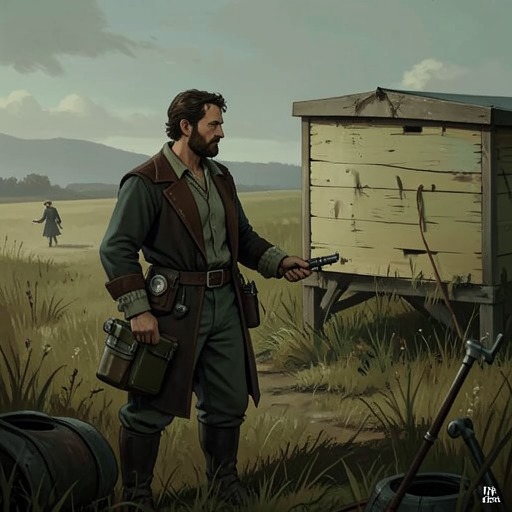
For Sergeyich, the hives are not merely a load to transport. He describes himself as the representative of the bees’ legitimate interests, while leaving their internal social arrangements to them: his work is to keep the colonies healthy, drive out wasps, uncap honeycombs, and collect honey, wax, and pollen. The bees do most of the labor, but their lives and his own have become inseparable. That relationship gives the hives a practical as well as personal importance when he prepares to leave: he must close their entrances, load them one by one onto a flatbed trailer, cover them with a tarpaulin, strap them down, and take jars of honey along as money.
Rain makes the departure safer for the colonies. In cooler conditions the bees are less likely to become agitated by the jolting road, heat their hives, and die; at around ten degrees, with rain cooling the journey, Sergeyich judges the weather almost ideal. The care is exact and physical, not abstract sentiment: the entrances must be shut for travel, the hives firmly tied down, and later a loosened board has to be pressed back into place so a bee cannot escape through the crack.
Damage, Repair, and Discovery
The trailer carries a hive marked by an axe, whose base board comes loose again during the drive. Sergeyich pulls over to fix it, first blowing a bee back inside before pressing the board shut. Later, when the damaged hive is beside the last hive on the trailer, he has no hammer; he uses pliers and a heavy spark-plug wrench to reposition a nail. He apologizes to the bees before striking, and tries to work lightly so he will not frighten them. The repair is interrupted by a sound from inside, as if something heavy has rolled down through the hive.
Lifting the roof and drawing out combs, Sergeyich finds a green grenade crawling with bees: the same grenade Petro gave him the previous winter. The discovery changes the meaning of the hive from shelter and working equipment to a concealed danger that has travelled with him. He remembers the checkpoints and customs inspections the vehicle has passed and fears the consequences if the weapon had been found. The bees have covered the grenade, but their presence has not neutralized it; the ordinary business of keeping a colony has accidentally concealed a weapon in the cargo.
The Grey Hive and the Dream
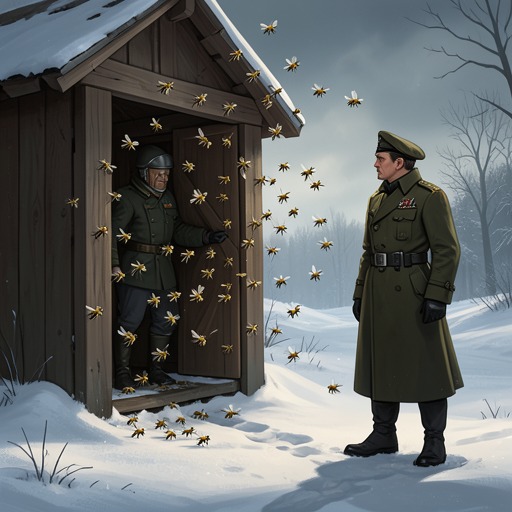
On the road, Sergeyich dreams that enormous grey bees emerge from a hive and move like military scouts toward his home in Little Starhorodivka. Later, when he looks again at the trailer, he recognizes one hive as the source of that vision. He recalls another dream of figures appearing from dark woods and takes both dreams as divine guidance. In the hive, a few bees look grey to him. His questions about disease, biological weapons, and possible surveillance equipment show how the image of an armed enemy has entered his reading of the colony; suspicion attaches not just to individual bees but to the hive that holds them.
Sergeyich unstraps the hive, pulls it free from its neighbor, and carries it about a hundred metres from the Lada, pausing on the way. He checks the combs and the hive’s smooth inner walls, but finds no proof of the imagined threat. Even so, the feared possibilities remain compelling to him. He leaves the roof off, takes the grenade, and throws it from roughly twenty metres away before throwing himself to the ground. The explosion destroys the hive completely: where it stood there is a crater, scattered wood, and a fragment of comb. A bee flies past, and Sergeyich hopes that some of the colony survived.
A Survivor and the Limits of Shelter
After the blast, one bee flies from the direction of the explosion and lands at the entrance of a hive Sergeyich repaired during the journey. Because the entrance has been closed for transport, he climbs onto the trailer, removes the strap, lifts the roof, and opens it. He invites the newcomer inside. It crawls in eagerly, but three or four resident bees immediately push it back out and shove it from the landing. The gesture makes plain that preserving a bee is not the same as restoring it to a community: the other colony does not accept the stranger simply because Sergeyich has made an entrance available.
He lifts the rejected bee from the ground, places it on his palm, and closes his fist around it like a small hive. Elsewhere, as he explains how he will hide the grenade from inspection, he says he will conceal it among the bees, where no one will reach into the hives. The contrast is stark: they can serve as cover for a weapon, but they are also beings he tries to keep alive and a society with boundaries of its own. Across the journey, the beehives are at once cargo, workplace, shelter, and a fragile network of belonging. The destruction of the grey hive does not resolve the conflict between fear and care; the rejected bee leaves that conflict visible in miniature.